

G&L Guitars: Leo Fender's Last Company
The man who designed the Telecaster, the Stratocaster, and the Precision Bass never stopped innovating. His last company, G&L, never got the credit it deserved. Here's what to know about G&L instruments, and what to look for if you're considering one.
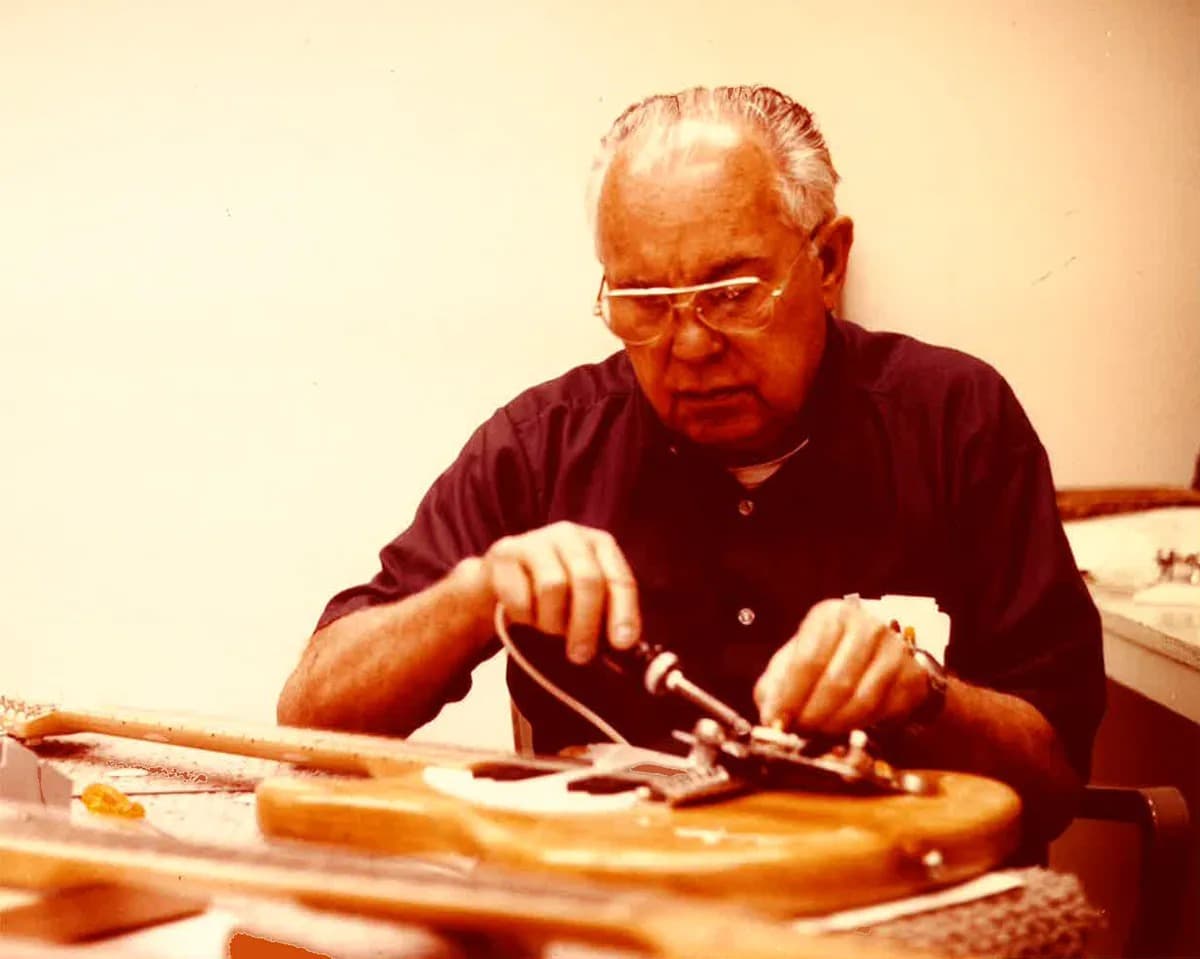
After 45 years on Fender Avenue in Fullerton, G&L Musical Instruments shut down in the autumn of 2025. The factory where Leo Fender built guitars in the last years of his life, and where his team kept building them for more than three decades after, is shut. BBE Sound, the parent company since 1991, has dissolved. There won't be any more new USA-made G&Ls.
For a brand that operated at a deliberately small scale, with modest marketing, a working-player roster instead of a billboard one, and hand-finished instruments coming out of a single facility, this is an ending that fits the company. Quiet. But the guitars themselves weren't quiet, and the people who own them have known that for years.
Here's what to know about the instruments Leo built last, and what to look for if you're considering one.
1980: G&L Is Born in Fullerton
Leo Fender founded G&L in 1980 with George Fullerton and Dale Hyatt, both longtime Fender colleagues. The factory sat on Fender Avenue in Fullerton, the same city where Leo had built the original Fender company decades earlier.
Leo had sold the original Fender company to CBS in 1965. The years between then and G&L were the Music Man years. Through his R&D firm CLF Research, Leo developed instruments for Music Man, including the StingRay bass, and served as the company's president. By 1979 the partnership had soured and he walked away. He was 70, with three decades of inventing behind him and the spark for one more company in front. The next year, he founded G&L.
Leo's process didn't change. Prototypes, working players, feedback, iteration: the same method he'd used at Fender and Music Man. What was new at G&L was the set of ideas he wanted to pursue, now under his own roof.
What Made G&Ls Different
If you only ever play one G&L, the first thing you'll notice is that it doesn't feel quite like a Fender, even when it looks like one. That's deliberate. Across the 1980s, Leo and his team built a distinct toolkit of pickups, hardware, and tone circuits that became G&L's signature.
MFD pickups (Magnetic Field Design). G&L's proprietary single-coil-sized pickup, built around a ceramic magnet with adjustable pole pieces. The voice is unmistakable: bright, articulate, generous in the low end, with a lot of headroom on tap. They run hotter than a traditional alnico single, closer to a humbucker in feel, without losing the snap and definition of a single. Once you've heard a pair, they're easy to pick out.
The idea didn't come out of nowhere. Leo had been working on this kind of pickup at Music Man in the 1970s. The StingRay's big humbucker, with its giant adjustable pole pieces and (eventually) ceramic magnets, was built on the same philosophy. At G&L, he brought that approach to a single-coil-sized package with each pole piece individually height-adjustable. The MFD is, in a real sense, the StingRay idea applied to a six-string.
Every feature on a G&L exists because he believed in it.
The Saddle-Lock bridge. A Tele-style six-saddle bridge with a side-mounted screw that clamps the saddles together into a single mass, transferring more string energy into the body. The audible result is more sustain and a tighter low end. Patented G&L hardware. You don't find it on anything else.
The Dual-Fulcrum vibrato. G&L's two-point tremolo system, in place of the six-screw vintage Strat arrangement. Smooth under the hand, returns to pitch reliably, bends up as well as down. It's also easier to manufacture consistently. Leo always cared about that.
PTB (Passive Treble and Bass) tone circuit. Two passive tone controls cutting treble and bass independently. Sounds small on paper. In practice it opens up a range of voicings: you can roll off a brittle high end without losing presence, or tighten up a muddy low end without thinning the whole guitar.
Neck construction. G&L necks lean comfortable. G&L's Bi-Cut neck construction, used through 2006, was known for producing famously stable results. Many models also feature multi-radius fingerboards and an adjustable neck-tilt mechanism that lets you fine-tune the angle without unbolting. Tight bolt-on joints, well-dressed frets.
None of this was marketing. Leo wasn't a marketing person. Every feature on a G&L exists because he believed in it.
The Big Models You Should Know
G&L's catalog was focused. A handful of models defined the brand and stayed in the catalog through most of its run. These are the ones to know.
The ASAT (1986) is G&L's take on the Tele shape, loaded with MFD pickups and the Saddle-Lock bridge in its original form. Same overall silhouette as a Telecaster, but its own voice: fatter, hotter, with that MFD clarity. The name traces back to the Air Force's Anti-SATellite weapon program (yes, really). The line branched out from there into the more traditional ASAT Classic and the beefier, almost P-90-flavoured ASAT Special.
The Legacy (1992) is G&L's Strat-shaped guitar: alnico single-coils, three-pickup layout, the Dual-Fulcrum vibrato, the PTB tone circuit. Released shortly after Leo's death, it carried his design language through G&L's BBE-era output and stayed in the catalog as a workhorse for the rest of the brand's run.
The S-500 is the Legacy's louder cousin, and actually the older one, dating to 1982. Same body shape, MFD pickups instead of alnico. Hot, aggressive, articulate.
The Comanche is the unusual one in the catalog. Three split Z-coil pickups (the staggered shape is visually unmistakable) give you a hum-cancelling solution without sacrificing single-coil character.
The L-2000 bass is one of G&L's early bass designs and one of the most versatile production basses ever built. Active/passive switching, series/parallel wiring, two MFD humbuckers. Ask any bass player who's owned one.
The Players Who Knew
G&L was never a billboard brand. It didn't run stadium-tour sponsorships or six-figure endorsement deals. But the players who picked up a G&L tended to keep one, and a few have put them on records you've definitely heard.
Jerry Cantrell of Alice in Chains is probably the most visible. His 1984 G&L Rampage, the "Blue Dress" guitar (named for the pin-up sticker on its body), became one of the defining sounds of the Seattle grunge era. Cantrell has had multiple G&L signature models since.
Tom Hamilton, Aerosmith's bassist and one of the band's founding members, has played G&L ASAT basses as his main instruments since the mid-1990s. His signature ASAT Bass, with its Western Sugar Pine body, proprietary "Hamiltone" MFD humbuckers, and metal-flake finishes, is one of the more distinctive signature basses G&L ever made.
Carl Perkins, the rockabilly pioneer who wrote "Blue Suede Shoes," played a G&L Broadcaster as his main guitar in his later years. He was an old friend of Leo Fender.
Bernard Edwards of Chic can be spotted with what looks like a G&L L-1000 in studio footage from the Power Station's 1985 "Get It On" sessions, which he produced. Dee Murray, Elton John's longtime bass player, played one too; he was the featured artist in G&L's 1981 advertising.
Will Ray of The Hellecasters, one of country guitar's most distinctive voices, was a longtime G&L signature artist.
Nate Navarro, Berklee graduate and touring bassist for Porcupine Tree and Devin Townsend, has championed the brand on his bass-focused YouTube channel, introducing G&L to a younger audience.
The thread across that list is players who needed an instrument to work, night after night, and didn't care which logo was on the headstock.
The Quiet End
The end came quickly. After signs of strain through 2023 and 2024, with a post-COVID demand drop and model launches without much marketing push, G&L's full production staff was furloughed on September 15, 2025, after several weeks of unpaid wages. Two weeks later, on September 29, all employees were formally terminated and given severance.
By the end of October, G&L's parent company BBE Sound had terminated its corporate status with the State of California. The factory and production assets were liquidated separately, with remaining inventory sold to a wholesaler.
There was no formal announcement, no farewell model, no press conference. After 45 years on Fender Avenue, the factory closed.
What it means in practice: the supply of new G&Ls is fixed at whatever was already in the world by autumn 2025. The used market is the only market.
Buying a G&L Today
Every G&L is now a used-market purchase. Here's the rough landscape.
USA vs Tribute. The G&L Tribute series, introduced in the 2000s, brought overseas-built versions of G&L designs to a lower price point. Tributes are real G&Ls with proper G&L hardware and electronics, just built offshore. If you want the engineering on a working musician's budget, they're the best value entry. USA G&Ls (pre-October 2025, all built in Fullerton) are the higher tier, and the pool of those is now finite.
Era considerations. Pre-BBE-era guitars (1980 to 1991, while Leo was alive) carry the strongest collector premium. These are the ones with Leo's personal sign-off, often literally; early Broadcasters had inspection stickers signed by Leo himself. The 1990s and 2000s USA G&Ls are the sweet spot for working players: high build quality, distinctive designs, affordable enough not to be afraid of taking on tour. Late-period USA models (2015 to 2025) are the most modern execution and represent the final wave of factory output.
What to check. On any used G&L, look at the Saddle-Lock bridge mechanism (the side screw should clamp smoothly), the MFD pole pieces (they should adjust without sticking), the truss rod, and the original case and paperwork if collector value matters to you. Serial number date decoding is well-documented across G&L forums and resource sites.
What G&L spent 45 years building is still out there. The Rampages, the Legacys, the L-2000s, and the ASATs already in circulation will keep doing what they've always done, in the hands of working musicians who care more about the instrument than the logo. The closure changes the supply, not the guitars themselves.